When many small business owners think of cyberattacks, they picture multi-billion dollar multinational conglomerates being held ransom by international criminal syndicates. This “it won’t happen to me” mindset is exactly what cybercriminals are counting on.
The hard reality of 2025 and 2026 is that small and medium-sized businesses (SMBs) have become the primary, most lucrative targets for modern cybercriminals. Lacking the massive defense budgets and dedicated security teams of enterprise-level operations, small businesses present highly valuable targets with minimal defenses.
The Reality Check: Small Businesses Are in the Crosshairs
The numbers tell a story that cannot be ignored. Small businesses are no longer suffering “collateral damage” in global cyber wars; they are directly on the frontlines:
- 43% of all cyberattacks now target small and medium-sized businesses.
- 80% of SMBs experienced at least one cyberattack in 2025 alone.
- SMBs suffer 4x more confirmed breaches than larger organizations.
Why Small Businesses Are Prime Targets
Cybercriminals are rational actors who operate on a simple business model: low effort, high reward. Small businesses perfectly satisfy both criteria:
- Valuable Data: Small organizations store the exact same customer records, medical histories, financial accounts, and credit card processing data as major corporations.
- Weaker Defenses: Close to 47% of businesses with fewer than 50 employees have zero cybersecurity budget, leaving them exposed.
- The Supply Chain Gateway: Nearly 30% of breaches now involve a third-party supplier. Hackers use vulnerable SMB partners as a backdoor to break into larger enterprise networks.
- Human Exploitation: Small businesses suffer 350% more social engineering attacks targeting employees compared to larger, well-trained organizations.
The Top Attack Vectors: Ransomware and Phishing
The two most destructive threats to modern businesses work in tandem: Phishing is the key that opens the door, and Ransomware is the payload that locks down the network.
1. Ransomware: The Ultimate Business Disrupter
Ransomware accounts for a massive 88% of SMB breaches, compared to just 39% for larger organizations. Once inside, modern automated attack software can move from initial infiltration to encrypting a business’s entire network in less than 4 hours.
Paying the ransom is no guarantee of relief; 69% of small businesses that paid a ransom were hit by subsequent attacks. Furthermore, the financial aftermath is staggering, with average recovery and downtime costs ranging from $120,000 to $1.24 million.
2. Phishing: Over 95% of Incidents Start with Human Error
1 in 323 emails hitting a small business’s inbox is targeted and malicious. Approximately 42% of small businesses fell victim to phishing in 2025 alone. With 95% of cybersecurity breaches originating from basic human error, the employee inbox remains the single greatest vulnerability.
The Financial Death Blow: The impact is swift and unforgiving. The average breach cost for businesses under 500 employees is $3.31 million. 1 in 5 SMBs would close their doors forever following an attack, and 55% state that a loss of $50,000 or less would put them completely out of business.
The New Frontier: AI-Powered Cybercrime
The cyber landscape of 2025 and 2026 has been fundamentally altered by Artificial Intelligence. Cybercriminals are now using AI to orchestrate rapid, highly sophisticated campaigns targeting small businesses:
- AI-Driven Assaults: A staggering 41% of cyberattacks on SMBs are now AI-driven, contributing to a 340% surge in modern, automated attacks.
- Deepfakes and Social Scams: Criminals caused $893 million in losses in 2025 using AI-generated spear-phishing campaigns, automated vulnerability scanning tools, and convincing deepfake voice notes mimicking executives.
Your Security Checklist: 10 Actions to Take Today
Do not let your business remain an easy target. Review the checklist below and implement these 10 industry-standard, actionable practices right now:
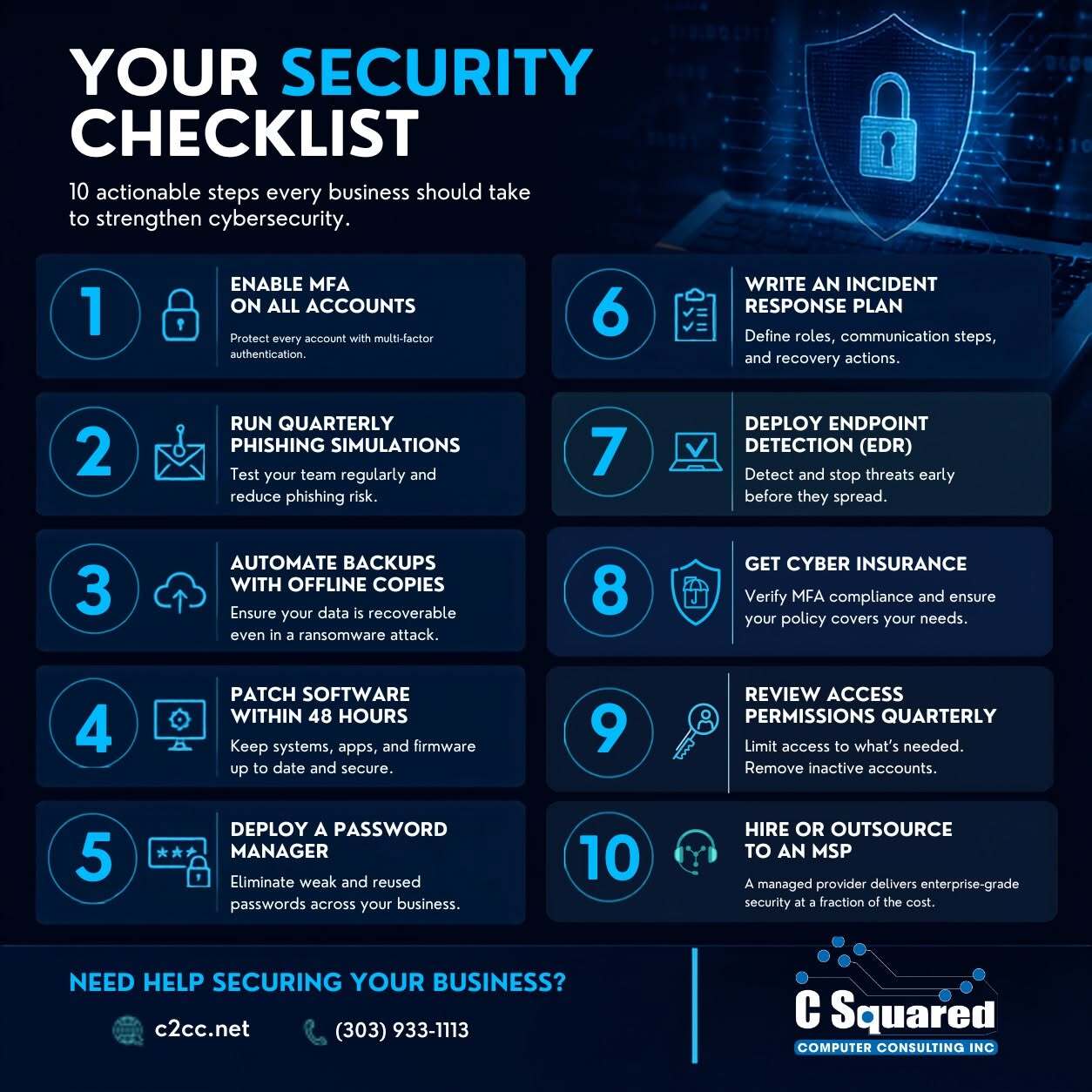
- Turn on Multi-Factor Authentication (MFA) everywhere. It blocks up to 99.9% of automated account-compromise attempts.
- Replace legacy antivirus with EDR. Endpoint Detection and Response stops ransomware in real time, before it spreads.
- Keep automated, offline, regularly tested backups. The only foolproof way to recover from ransomware without paying.
- Train your team to spot phishing. 95% of breaches start with human error, so your inbox is the front line.
- Patch and update everything. Hackers scan for outdated software and exploit known vulnerabilities.
- Enforce strong, unique passwords. Use a password manager so no credential is reused across accounts.
- Vet and limit third-party vendor access. Nearly 30% of breaches come through a supplier or partner.
- Filter and monitor email. Stop malicious messages before they reach an employee’s inbox.
- Build and test an incident response plan. Know exactly who does what before an attack, not during one.
- Partner with an MSP for 24/7/365 monitoring. Get an entire certified security team for a fraction of one full-time salary.
Get Your Free Security Assessment
Frequently Asked Questions (FAQ)
Q1: Why would a hacker target my small business when there are much larger companies to hack?
A: Cybercriminals operate on efficiency. While large enterprises have massive payouts, they also spend millions on defense. Small businesses offer a “path of least resistance.” Hackers use automated tools to scan the internet for vulnerabilities, meaning they target weaknesses, not names. Small businesses are also often used as gateways to compromise the larger corporations they partner with.
Q2: We have basic antivirus software installed. Is that enough?
A: Unfortunately, no. Legacy antivirus relies on databases of known threats. Modern hackers use polymorphic malware and AI-driven techniques that bypass traditional signature-based detection. You need Endpoint Detection and Response (EDR), which monitors file behavior dynamically to block threats like ransomware in real time before they spread.
Q3: If we are hit by ransomware, should we just pay the ransom to get our data back?
A: Cybersecurity and law enforcement agencies strongly advise against paying. Statistics show that 69% of small businesses that pay are targeted again because attackers now know they are willing to pay. Paying also does not guarantee you will get 100% of your data back. The only foolproof recovery method is maintaining automated, offline, and regularly tested backups.
Q4: What is Multi-Factor Authentication (MFA), and is it really that important?
A: MFA requires users to provide two or more verification factors to gain access to an account (such as a password plus a code sent to a mobile app). It is arguably the single most cost-effective security measure you can take, blocking up to 99.9% of automated account-compromise attempts.
Q5: How does outsourcing to a Managed Service Provider (MSP) compare to hiring an internal IT person?
A: For most small businesses, a full-time, dedicated cybersecurity professional is financially out of reach. An MSP provides an entire team of certified experts, 24/7/365 monitoring tools, and enterprise-grade security protocols for a fraction of the cost of a single full-time salary.
Don’t Wait for the Attack — Protect Your Business Today
The cost of proactive protection is a fraction of the cost of recovering from a devastating breach. C Squared Computer Consulting Inc is here to lock down your network, train your employees, and give you complete peace of mind.